
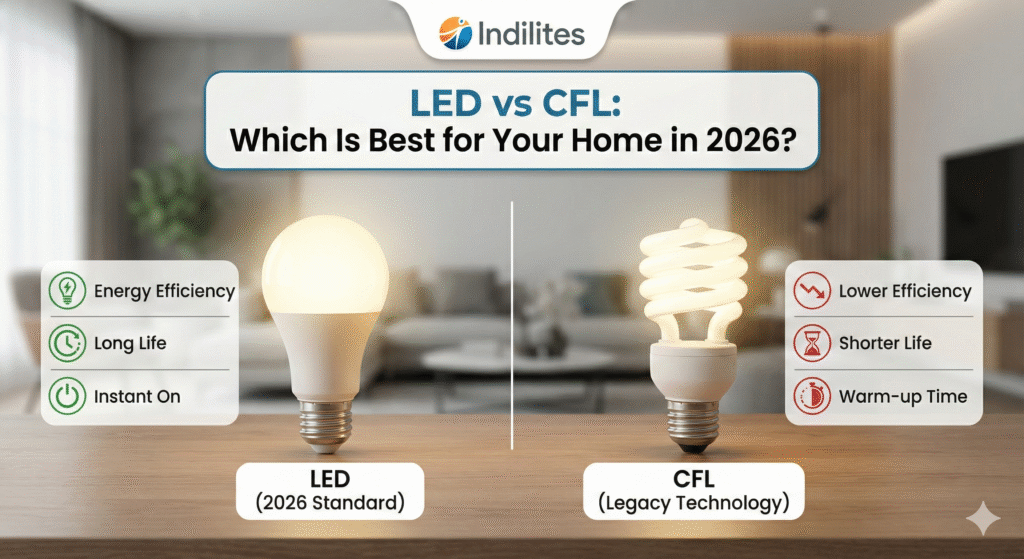
LED vs CFL: Which Is Best for Your Home in 2026?
If you are still wondering:
“LED better hai ya CFL?”
You are not alone.
Millions of Indian households are shifting from CFL to LED because of:
- rising electricity costs
- smart home adoption
- sustainability awareness
- better lighting quality
But before upgrading, you should clearly know:
✔ Which bulb lasts longer
✔ Which one consumes less electricity
✔ Which one is safer
✔ Which gives better value over years
Let’s break it down simply — with real examples and practical insights.
Table of Contents
- What Are CFL and LED Lights? (Simple Definition)
- Key Differences Between LED and CFL
- LED vs CFL — Detailed Comparison Table
- Cost Comparison Over 3–5 Years
- Where LEDs Work Best
- Where CFLs Still Make Sense
- Safety & Environmental Impact
- How to Switch from CFL to LED (Step-by-Step)
- India-Specific Insights (2025–2026)
- Pro Tips Box
- People Also Ask (PAA)
- FAQs
- Bullet Summary
- Conclusion
- CTA
- Keyword List
What Are CFL and LED Lights? (Featured Snippet Style)
CFL (Compact Fluorescent Lamp)
CFL bulbs use gas and mercury vapor to create light when electricity passes through them.
They take a few seconds to warm up and glow fully.
LED (Light Emitting Diode)
LED bulbs use small diodes that convert electricity directly into light — with minimal heat and maximum efficiency.
They glow instantly and consume significantly less power.
Key Differences — Simple Breakdown
- LED = newer, energy-efficient, long-lasting
- CFL = older, cheaper initially but high long-term cost
Let’s compare in detail.
LED vs CFL: Detailed Comparison Table
| Factor | LED | CFL |
| Power Consumption | Very low | Moderate |
| Lifespan | 25,000–50,000 hrs | 6,000–10,000 hrs |
| Heat Produced | Very low | Medium |
| Environmental Impact | No mercury | Contains mercury |
| Brightness Quality | Consistent & controlled | Flicker sometimes |
| Startup Time | Instant | Few seconds |
| Dimmable Options | Available | Limited |
| Cost (Initial) | Higher | Lower |
| Maintenance | Very low | Needs replacements |
Winner for homes: LED — almost in every parameter.
Cost Comparison: Real Example (Indian Home)
Assume one 10W LED vs 18W CFL used 6 hours daily.
Electricity Cost (Per Year)
- LED: lower consumption → lower bill
- CFL: higher consumption → higher bill
Over 3–4 years, LED usually saves:
✔ 40–60% electricity
✔ fewer replacements
✔ nearly double lifespan
Result?
LED becomes cheaper than CFL — even if purchase price is higher.
Where LEDs Work Best
Use LEDs for:
- living rooms
- kitchens
- bedrooms
- study rooms
- shops and showrooms
- outdoor spaces
- smart homes
They are ideal when you need:
✔ instant brightness
✔ consistent lighting
✔ long-term value
Where CFLs Still Make Sense
CFLs may still be used:
- in rarely used rooms
- temporary spaces
- low-budget setups
But keep in mind: they are slowly phasing out worldwide.
Safety & Environmental Impact
LED Safety
- no mercury
- cooler operation
- less risk of breakage issues
CFL Safety Concerns
- breaks → mercury exposure risk
- must be disposed properly
- can heat up more
For homes with kids, elderly, or pets — LEDs are safer.
How to Switch from CFL to LED (Step-by-Step)
Step 1: Check Wattage Equivalents
- Replace 18W CFL → 9–10W LED
- Replace 23W CFL → 12W LED
Step 2: Choose Color Temperature
- Warm white (3000K) — bedrooms
- Neutral white (4000K) — living rooms
- Cool white (6500K) — kitchens, study areas
Step 3: Pick the Right Base
B22 (pin type) or E27 (screw type).
Step 4: Choose Quality Brand
Avoid cheap, non-certified LEDs.
India-Specific Insights (2025–2026)
- Government drives encourage LED adoption in cities and towns
- Builders prefer LEDs in new flats and societies
- Smart homes use Wi-Fi/voice-enabled LED bulbs
LEDs are becoming default lighting in Indian homes.
PRO TIPS BOX
- Prefer high-efficiency LEDs with warranty
- Check lumens, not only watts
- Avoid ultra-cheap bulbs
- Choose correct color temperature
- Replace CFLs gradually if on tight budget
PEOPLE ALSO ASK
1. Which is better — LED or CFL for home use?
LED is better because it saves more power, lasts longer, produces less heat, and is safer.
2. Do LED bulbs save more electricity than CFL?
Yes — LED bulbs consume significantly less electricity while giving the same brightness.
3. Are LED bulbs more expensive than CFL?
Initially yes, but LEDs save more money over time because they last longer.
4. Which light is brighter — LED or CFL?
Both can be bright, but LEDs maintain more consistent light output.
5. Do LED bulbs last longer than CFL?
Yes — LEDs can last 2–4 times longer than CFL bulbs.
6. Are CFL bulbs harmful?
CFLs contain mercury and require careful disposal.
7. Do LEDs produce heat?
Very little, compared to CFL and halogen.
8. Can LEDs replace CFL directly?
Yes — just match the holder type and wattage equivalent.
9. Which is more eco-friendly: LED or CFL?
LED is more eco-friendly because it does not contain mercury.
10. Do LEDs work well with inverters?
Yes — they require less power, so they last longer during power cuts.
11. Can LED bulbs flicker?
Poor-quality LEDs may flicker; choose certified brands.
12. Are LEDs good for reading?
Yes — neutral white LED is best for study and reading areas.
13. Is it okay to use CFL in bedrooms?
You can, but LED is safer and more efficient.
14. Which bulb is better for kitchen lighting?
LED, because it offers bright, cool white light and low heat.
15. Is LED lighting good for eyes?
Good-quality LEDs with proper color temperature are comfortable for eyes.
FAQs
1. How much electricity can I save by switching to LED?
Households can save 30–60% on lighting costs depending on usage.
2. Do LEDs need frequent replacements?
No — they can run for years with normal home usage.
3. Are cheap LED bulbs worth buying?
Usually not — they fail early and flicker.
4. Do LEDs work outdoors?
Yes — choose weather-rated models.
5. What CRI should I choose?
Look for CRI 80–90+ for natural color appearance.
6. Can I dim LED lights?
Only if the LED supports dimming and the switch is compatible.
7. Are LEDs safe during power fluctuations?
Use surge protectors to stay safe.
8. Should I replace all CFLs at once?
Not necessary — replace gradually starting with most-used rooms.
BULLET POINT QUICK SUMMARY
- LEDs save more power than CFLs
- LEDs last longer
- LEDs are safer and eco-friendly
- CFLs are cheaper initially but costly long-term
- LEDs work better with smart homes
- LEDs reduce heat and maintenance
- CFLs contain mercury
- India is rapidly shifting to LEDs
- LED = better ROI
- Best choice for 2026 homes: LED
Final Conclusion
If you are choosing between LED vs CFL in 2026:
👉 LED is the clear winner.
You get:
✔ lower electricity bills
✔ better lighting quality
✔ longer lifespan
✔ safer and greener home
Invest once — benefit for years.
CTA — Consulting & Growth Angle
Whether you are:
- a homeowner upgrading lighting
- a builder planning new projects
- a retailer or franchise owner
- an interior designer
—we can help you choose the right LED solutions, procurement strategy, and cost-saving plan.
👉 Connect with us for lighting consultation, business growth, and franchise guidance.
Keyword List
Primary Keywords:
LED vs CFL, CFL vs LED, LED vs CFL comparison
Secondary Keywords:
LED benefits for home, CFL disadvantages, LED vs CFL power consumption, LED lifespan vs CFL
Long-Tail Keywords:
which is better LED or CFL for home
LED vs CFL electricity bill
how much power LED saves compared to CFL
LED vs CFL which lasts longer
best LED bulbs for Indian homes
is CFL safe for home lighting